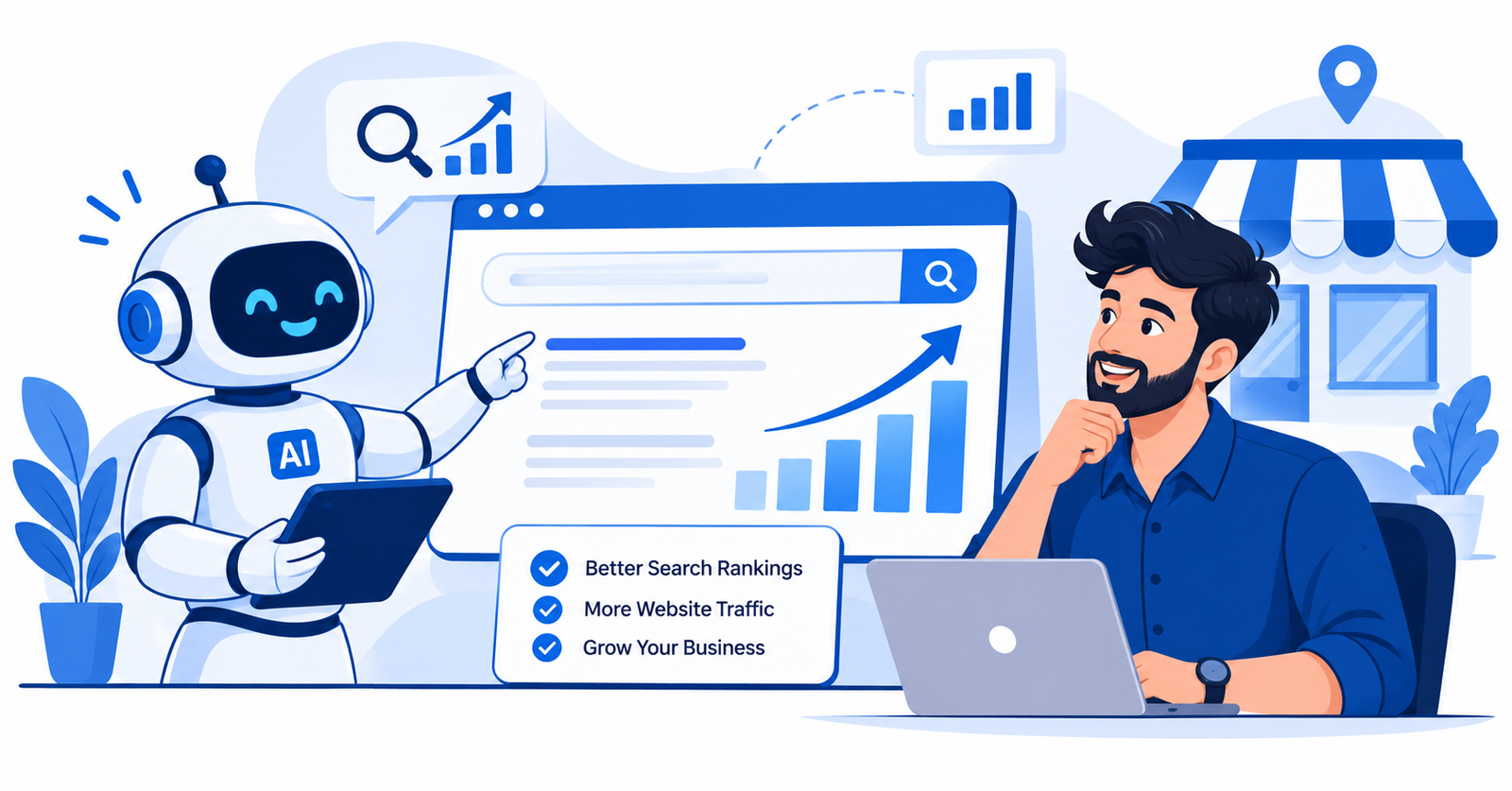
The shift in search continues as we adopt fresh methods to find local businesses, compare services and obtain answers online. Artificial intelligence interprets what users truly want from the terms they enter. AI SEO helps you understand what people really want from a search.
For your business, SEO involves more than placing keywords on a page. You need a website that combines relevant terms with useful content and a clear structure for navigation. In simple terms, AI SEO means using AI tools to support research, content and technical checks.
Artificial intelligence can support SEO by helping firms generate keyword ideas, study search trends and spot content gaps. When paired with human insight and a plan, it can improve decision-making and raise visibility in search. AI SEO works best when it supports helpful, original content.
How AI Is Changing SEO
AI offers businesses a clearer view of what people seek and why they search. Rather than focusing on keywords, AI tools can examine related topics and trending questions to gauge a target audience.Many owners now use AI SEO to find content gaps their competitors miss.
These AI-driven tools also help research ideas, interpret search intent, enhance existing pages and track SEO performance. However, AI should not replace human support. Companies must still verify results, apply their expertise and confirm that content answers real questions. A good AI SEO plan still needs a human to check every suggestion.
Ways AI Can Improve SEO
1. Better Understanding of Search Intent
People use Google for various reasons: some gather information, others compare choices, and some are prepared to hire a firm. AI can help businesses interpret these differences and shape content that matches what users seek.
For example, someone searching for “website maintenance services” might want details on what the service includes, its cost, or why maintenance is necessary. Answering such questions can support potential clients.
2. Improving Existing Content
Pages often hold useful material that may need refinement. AI can assist by suggesting edits where content needs clarity or extra detail. If you’re new to AI SEO, begin with keyword ideas and content outlines.
Businesses can review these points:
– Whether headings describe the issue clearly.
– If key information is absent.
– How naturally keywords appear.
– Whether the text stays on topic.
– What questions customers might raise.
– If related subjects need explanation.
Consider these suggestions before making changes. AI can help with editing, but human judgment is needed to verify facts, add experience, and keep content helpful.
3. Finding Related Topics and Ideas
A subject often connects to several areas users may want to explore. Covering some of these links lets a page offer a fuller answer rather than focusing on one angle.
For instance, a piece on SEO could address keyword research, technical SEO, content SEO, local SEO, and search intent. AI tools can reveal related topics and questions for your business. Small businesses can start AI SEO with free tools and one clear goal.
AI SEO vs Traditional SEO
AI does not replace traditional SEO. Instead, it can support and improve many parts of the SEO process.
|
Traditional SEO
|
AI-Supported SEO
|
|---|---|
|
Keyword research
|
Intent and topic analysis
|
|
Manual reporting
|
Automated data insights
|
|
Periodic optimization
|
Continuous monitoring
|
|
Individual topic planning
|
Broader topic relationships
|
Can AI Help With Content Creation?
AI can greatly accelerate content production, but publishing its output without revision may yield material that feels repetitive and provides little benefit to readers. Editing AI-generated drafts before posting them to the website is therefore necessary. Used carefully, AI SEO can improve how your pages match real questions.
AI can assist with:
- Identifying topics: Determining which subjects might draw your audience.
- Outlining: Planning content before drafting a full article.
- Addressing common questions: Finding the kinds of queries readers may have about your product or service.
- Generating ideas: Offering alternative approaches for a blog post or web page.
- Structuring: Arranging information into a well-structured form.
- Copyediting: Rewording unclear sentences to enhance clarity and comprehension.
- Filling gaps: Locating questions or content missing from the current page.
Even so, a human review of AI suggestions remains essential. Facts must be checked, the style should align with the brand, and the material ought to convey genuine insight rather than merely repeating what others have produced.
The most effective approach is to use AI’s strength to shorten research and planning time while ensuring the content delivers real value to those who read it.
AI and the Future of Search Visibility
Search is becoming more conversational. Users are increasingly asking complete questions instead of searching only for short keywords. That’s why AI SEO is now part of many local business marketing plans.
AI-powered search experiences can also provide summarized answers and recommendations based on information available across different sources.
For businesses, this creates a need for content that is:
- Clear
- Relevant
- Well structured
- Informative
- Easy to understand
- Supported by trustworthy information
Businesses should therefore think beyond ranking for individual keywords and focus on building strong topical authority and useful digital information.
How JOD Digital Studio Uses AI in SEO
At JOD Digital Studio, we use modern AI-supported SEO approaches to help businesses improve their digital visibility while keeping strategy and content focused on real users.
Our approach can include:
- Search Intent Research
Understanding what potential customers are searching for and what information they expect to find.
- Content Optimization
Improving existing content structure, relevance and clarity.
- Semantic SEO
Building stronger relationships between related topics, services and important search concepts.
- AI Search Optimization
Preparing content to be more understandable across modern AI-powered search experiences.
- Content Gap Analysis
Identifying useful topics and questions that existing website content may not cover.
- Performance Monitoring
Reviewing search visibility and content performance to identify future optimization opportunities. Track your results, because AI SEO needs testing like any other strategy.
Why Businesses Should Pay Attention to AI SEO
How does AI alter how people look for information? Search engines are developing as online tools for locating what people need. As a business, you must refresh website content regularly and refine its presentation.
Meanwhile, AI cannot replace strong SEO. It may help with research, planning, and content analysis, yet your site still requires useful material, clear service pages, rapid speeds, reliable technical SEO, and a sensible visitor experience. Remember that AI SEO isn’t a shortcut, it’s a way to work faster and smarter.
By combining these fundamentals with AI-enabled tools where they are effective, businesses can reinforce their SEO strategy and endure shifting search trends.
Final Thoughts
Artificial intelligence is changing SEO by making research, analysis and content optimization more efficient. It also provides businesses with new ways to understand search intent, topics and changing user behavior.
However, successful SEO still depends on providing useful information and creating a website that genuinely helps visitors.
AI can make the process smarter and faster, but the objective remains the same: help the right people discover the right information at the right time.